Outcome charts pilot project: for their welfare and yours
DOI:
https://doi.org/10.53607/wrb.v43.294Keywords:
wildlife rehabilitation, triage, timely decision making, euthanasia, captive placement, release to the wildAbstract
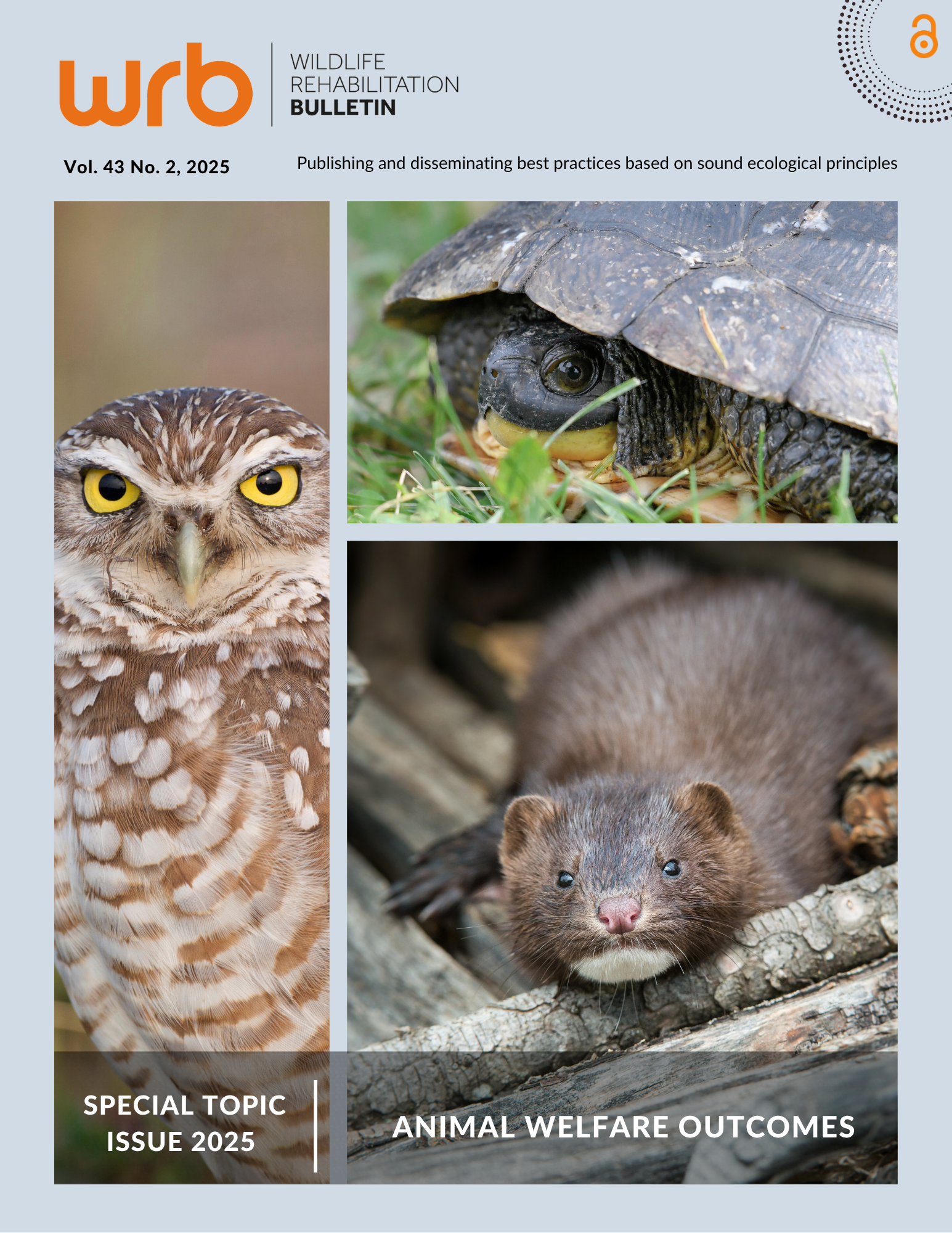
As a veterinarian or rehabilitator, it can be hard to make triage decisions for displaced, ill or injured animals. Does this animal have a good likelihood of release? Should it be euthanized? What about permanent placement? While some of this information exists in codes, standards, publications and anecdotes, navigating it can be difficult. Partners for Wildlife staff and fellows, along with subject-matter-experts have compiled outcome charts for seven groups or specific species of commonly presented wildlife: bats; cervids; freshwater turtles; mink (Neogale vison); rabbits and hares; raptors and vultures (Cathartes aura and Coragyps atratus). These concise charts are designed to promote timely and humane decisions for their welfare and yours.
Downloads
References
Association of Shelter Veterinarians’ (ASV) Guidelines for Standards of Care in Animal Shelters. file:///C:/Users/Owner/Downloads/JSMCAH_A_42_O%20(1).pdf Accessed June 2024.
Clapham, M. O., Martin, K. L., Davis, J. L., Baynes, R. E., Lin, Z., Vickroy, T. W., ... & Tell, L. A. 2019. Extralabel drug use in wildlife and game animals. Journal of the American Veterinary Medical Association. 255(5), 555-568.
Cooper, J. and Cooper, M.E. 2006. Ethical and legal implications of treating casualty wild animals. In practice. 28(1), pp.2-6.
Cope, H. R., McArthur, C., Dickman, C. R., Newsome, T. M., Gray, R., & Herbert, C. A. 2022. A systematic review of factors affecting wildlife survival during rehabilitation and release. PLoS One. 17(3), e0265514.
Fraser, D., Weary, D. M., Pajor, E. A., & Milligan, B. N. 1997. A scientific conception of animal welfare that reflects ethical concerns. Animal Welfare. 6, 187-205.
George, K. A., Slagle, K. M., Wilson, R. S., Moeller, S. J., & Bruskotter, J. T. 2016. Changes in attitudes toward animals in the United States from 1978 to 2014. Biological Conservation. 201, 237-242.
Hagen, C. A., Goodell, J. M., Millsap, B. A., & Zimmerman, G. S. 2024. ‘Dead birds flying: can North American rehabilitated raptors released into the wild mitigate anthropogenic mortality?. Wildlife Biology. e01283.
Hampton, J. O., & Teh‐White, K. 2019. Animal welfare, social license, and wildlife use industries. The Journal of Wildlife Management. 83(1), 12-21.
Hampton, J. O., Jones, B., & McGreevy, P. D. 2020. Social license and animal welfare: Developments from the past decade in Australia. Animals. 10(12), 2237.
Inzani, H., & Williams, D. L. 2018. Comparison of rehabilitation rates of birds of prey from a raptor rehabilitation centre ten years apart. Int. J. Avian Wildl. Biol. 3, 447-451.
Kirkwood, J. K. 2013. Wild animal welfare. Animal Welfare. 22(1), 147-148.
Miller E. A. 2012. Minimum Standards for Wildlife Rehabilitation. 4th edn. National Wildlife Rehabilitators Association and International Wildlife Rehabilitation Council.
Molina-Lopez, R.A., Casal, J. and Darwich, L. 2013. Final disposition and quality auditing of the rehabilitation process in wild raptors admitted to a wildlife rehabilitation centre in Catalonia, Spain, during a twelve year period (1995–2007). PLoS One. 8(4), p.e60242.
Monadjem, A., Wolter, K., Neser, W., & Kane, A. 2014. Effect of rehabilitation on survival rates of endangered Cape vultures. Animal Conservation. 17(1), 52-60.
Montesdeoca, N., Calabuig, P., Corbera, J.A. and Orós, J. 2017. A long-term retrospective study on rehabilitation of seabirds in Gran Canaria Island, Spain (2003-2013). PLoS One. 12(5), p.e0177366.
Mullineaux, E. 2014. Veterinary treatment and rehabilitation of indigenous wildlife. J Small Anim Pract. 55, 293-300.
Mullineaux, E., & Pawson, C. 2024. Trends in Admissions and Outcomes at a British Wildlife Rehabilitation Centre over a Ten-Year Period (2012–2022). Animals. 14(1), 86.
Orós, J., Montesdeoca, N., Camacho, M., Arencibia, A. and Calabuig, P. 2016. Causes of stranding and mortality, and final disposition of loggerhead sea turtles (Caretta caretta) admitted to a wildlife rehabilitation center in Gran Canaria Island, Spain (1998-2014): a long-
term retrospective study. PLoS One. 11(2), p.e0149398.
Partners for Wildlife - https://raptor.umn.edu/partnersforwildlife Assessed June 2024.
Schott, R. 2015. Can Wildlife Rehabilitators Really ‘Do No Harm’. J. Wildl. Rehabil. 35, 4-6.
Willette, M., Rosenhagen, N., Buhl, G., Innis, C., & Boehm, J. 2023. Interrupted Lives: Welfare Considerations in Wildlife Rehabilitation. Animals. 13(11), 1836.
World Organization of Animal Health (WOAH). https://www.woah.org/en/what-we-do/animal-health-and-welfare/animal-welfare/ Accessed June 2024.
Published
How to Cite
Issue
Section
Categories
License
Copyright (c) 2025 Michelle Willette, Gail Buhl

This work is licensed under a Creative Commons Attribution-NonCommercial-NoDerivatives 4.0 International License.
The copyright for articles in this journal is retained by the author(s), with first publication rights granted to the Wildlife Rehabilitation Bulletin and NWRA. Articles published as open-access in this journal are free to use and share with proper attribution in educational and other non-commercial purposes. To obtain reprint permission for articles that are not open access, please contact the journal editor.